
BAScloud at a Glance

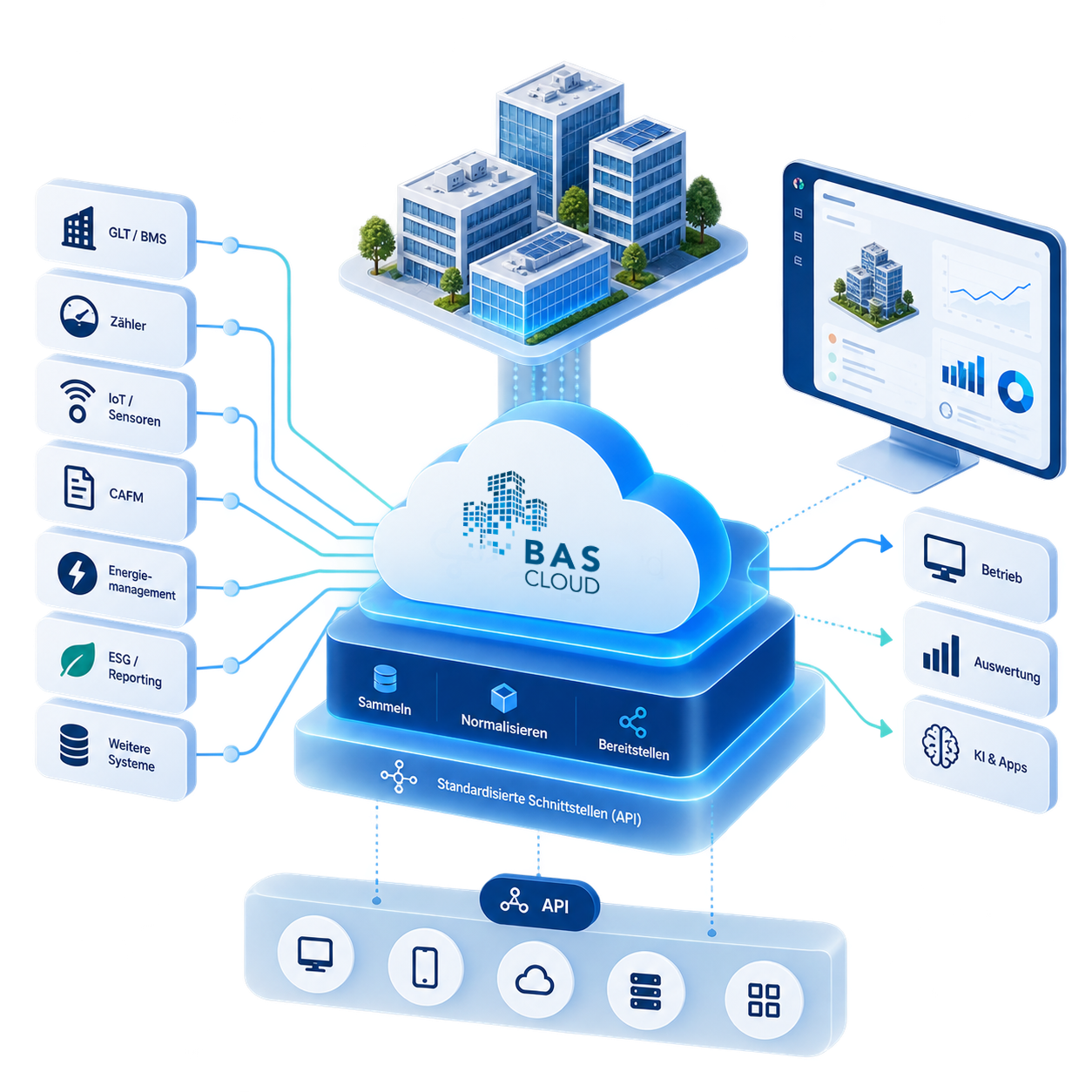
BAScloud is the central point at which data from a property is collected and made available for different systems: it consolidates technical building data from various source systems, normalises it, and provides it via standardised interfaces – serving as a central hub for the contextualised, operational data of a property.
What is BAScloud?

BAScloud performs three core tasks simultaneously:

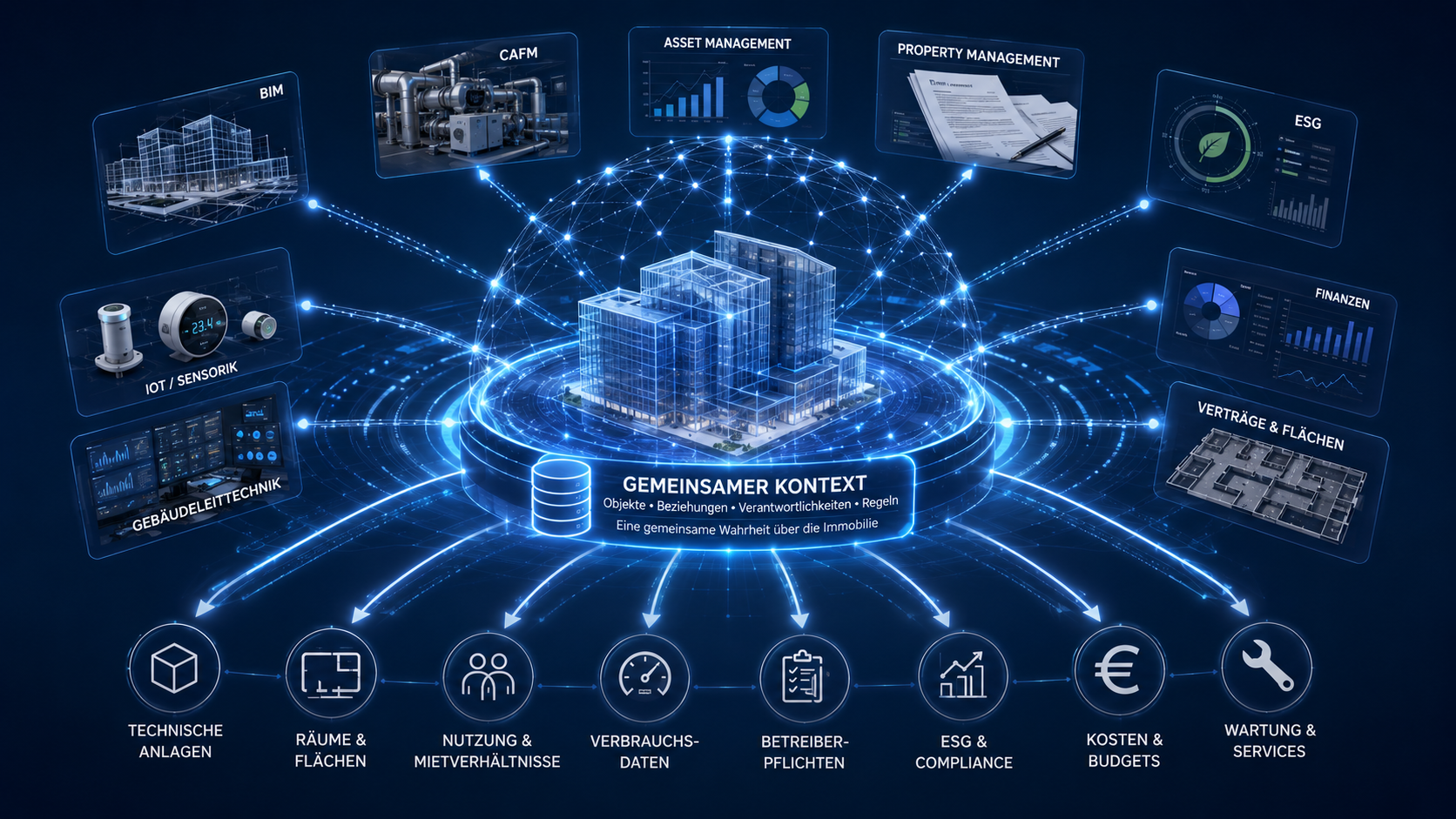
Unlike a single specialist application, BAScloud does not collect data for a single purpose – the platform creates a shared semantic data space that a wide variety of systems can access equally.

Data alone does not create added value

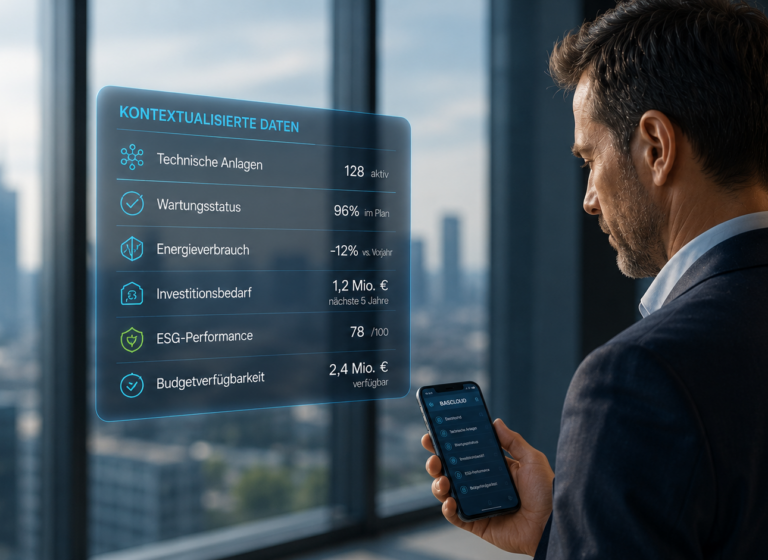
Only in conjunction with the building itself – with floors, usage areas, technical systems and their hierarchies – do measured values become reliable information on the basis of which economically sound decisions can be made. BAScloud therefore not only links raw data, but forms the data foundation for embedding it in the structural and spatial context of each individual building.

Asset Manager nutzt BAScloud App

This contextualised body of data is the foundation not only for BAScloud's own modules, but also for further applications – including future ones such as defect management, inventory management, maintenance planning, or individual analysis tools. Each new application draws on the same structured building context rather than rebuilding it from scratch.

One data foundation for all systems

Many companies today solve data problems on a per-application basis: for every new tool – an ESG reporting solution, billing software, an analytics dashboard – building data is collected, cleansed and adapted from scratch. This costs time, produces contradictory metrics and makes every new integration expensive.

BAScloud reverses this principle: data sources are connected centrally and quality-assured once. Every subsequent system – whether a BAScloud module or external software – accesses the same approved data state. New applications can be connected without repeating the underlying building integration.

BAScloud Datenplattform Grafik "Eine Wahrheit"

How it works

1

AnalysisWhich systems and data are available? Which consumption data are required?

2

ConnectMeters, sensors, building automation (BMS), IoT devices and existing specialist systems are connected to BAScloud – regardless of manufacturer or data format.

3

ProvideApproved, quality-assured data are delivered via standardised APIs to all connected target systems.

4

UseThe data are available in BAScloud modules (Dashboards, Virtual BMS, GreenMetrics, insightAI) as well as in ESG tools, billing systems, CAFM and asset management solutions.

Platform Architecture

BAScloud is built on four clearly separated layers. This separation ensures that new data sources or target systems can be connected without modifying existing integrations – the application layer can thus be extended as required with additional applications, including future ones, that access the same contextualised data set.

Connector-Icon

Connector Layer

BMS, IoT, Meters, Specialist systems, Manual data,

ChatGPT Image 30. Juli 2026, 15_16_16

Processing and Quality Layer

Normalisation, Standardisation, Plausibility checks, Historisation

ChatGPT Image 30. Juli 2026, 15_23_25

Provisioning layer

APIs, Data services, Roles & permissions, Data export

ChatGPT Image 30. Juli 2026, 15_25_18

Application layer

BAScloud modules ESG tools CAFM Defect management Inventory management Analysis tools Further target systems …

Advantages of BAScloud

These advantages are already in use today: BAScloud supplies more than 1,950 connected buildings across more than 20 corporate groups and capital management companies – including Deka Immobilien, HIH Real Estate, Catella and Uniper Energy – with a unified, quality-assured data foundation.
Every month, the platform processes around 87.5 million measured values at a stability of 99.9%.

From a single building to an international portfolio

BAScloud scales with the size of your portfolio. Whether a single building, multiple locations, or an international real estate portfolio with different languages, time zones, and system landscapes: the central data platform connects new properties step by step, without requiring changes to existing structures. Data quality, standardisation, and provision consistently follow the same rules – regardless of whether one building or a thousand buildings are connected.

Let us discuss your project.

Top